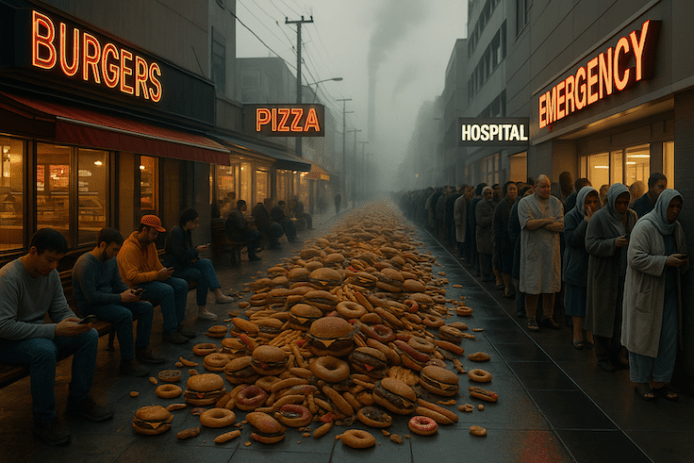
Introduction: The New Silent Pandemic
For most of human history, the primary threats to human life came from infections, accidents, and wars. Today, the biggest killers are chronic diseases such as obesity, diabetes, heart disease, cancer, and mental illnesses which now account for over 75% of global deaths.
Unlike the wars or pandemics of the past, which used to strike with acute and visible devastation but were often geographically confined, this health crisis has crept in silently, escalating slowly at first, building year after year until it now threatens to overwhelm healthcare systems, economies, and even entire societies worldwide.
What makes this coming crisis so insidious is that it is largely a man-made problem and one that could have been prevented if we had conducted a proper risk diagnostic and taken the right preventive actions from the start. Yet, instead of tackling its root causes, governments and healthcare institutions still today remain locked in a vicious cycle of focusing primarily on the consequences and managing them with treatments that do not solve the underlying problem and hence lead to more treatments feeding an endless cycle going nowhere.
The flawed logic seems to be: “If it’s not working, try harder!”
Billions are poured into pharmaceuticals and medical research, while little is done to address the real fundamental drivers of the epidemic: a toxic food production system, ultra-processed food, sedentary lifestyles, chronic stress, and widespread exposure to environmental toxins.
As the flywheel effect takes hold, where negative health patterns reinforce themselves and accelerate the crisis, the stakes are growing exponentially. If we continue down this path, future and even current generations will face rapidly declining health and life expectancy, unaffordable healthcare costs, and an extremely diminished quality of life.
Yet there is still hope. There are solutions to this crisis. The question is: will we act before the flywheel effect pushes us into a point of no return?
Background: The Emergence of a Global Health Crisis
The explosion of chronic diseases did not happen overnight. It has been many decades in the making, driven by shifts in food production, diet, lifestyle, and environmental conditions. Understanding the pace of its evolution can help us grasp the urgency of the problem.
Key Milestones in the Health Crisis Emergence:
- Starting in the early and mid-20th century, the rise of industrialized food production and fast food chains began transforming global diets, introducing mass consumption of highly processed foodsfilled with refined sugars, artificial additives, and unhealthy fats.
- By the 1980s and 1990s, sedentary lifestyles became the norm, exacerbated by urbanization, car dependency, office jobs, and digital technology that reduced daily movement compounding the impact on people’s health. Obesity rates began climbing.
- By the early 2000s, chronic diseases had overtaken infectious diseases as the leading causes of death worldwide. Governments and international organizations, including the World Health Organization (WHO), started sounding the alarm on obesity and non-communicable diseases (NDCs). Yet, despite the growing awareness, little was done to stem the tide.
- By 2010s, we observed alarming increases in childhood obesity, type 2 diabetes, and mental health disorders. Ultra-processed foods came to dominate over 50% of diets in many Western nations.
- The 2020s saw the COVID-19 pandemic exposed the fragility of human health. Those with underlying chronic conditions suffered more severe outcomes, and the world witnessed a surge in mental illness, cancer, and metabolic disease labeled by experts as “a global time bomb.” Life expectancy began to stall or even decline in some countries.
Where We Stand Today? It is Bad and it will get a lot Worse
- Obesity: Over one billion people worldwide are obese including many children (WHO, 2023)
- Heart Disease is the leading cause of death globally, accounting for 1 in 3 deaths. (CDC, 2023),
- Diabetes cases have skyrocketed to 537 million, a number expected to reach 783 million by 2045. (IDF, 2023)
- Mental health disorders such as depression and anxiety affect over 1 billion people, with suicide rates climbing, particularly among young people. (WHO, 2023)
- The rates of cancer are expected to rise by 60% over the next two decades, with many cases linked to lifestyle and environmental factors. (Global Cancer Observatory, 2023)
Why Are We Getting Sicker? A Risk Diagnostic of the Root Causes of the Crisis
The global health crisis with the explosion of chronic diseases can be traced to a complex interplay of interconnected risk factors such as dietary habits, sedentary behavior, mental health challenges, food production system, environmental pollution, and systemic failures in healthcare systems.
1. An Industrialized Food System Driven by Profit
One of the most significant contributors is the industrialized food system, which has prioritized quantity and private profit over quality and public health creating a toxic food environment. Ultra-processed foods loaded with sugar, unhealthy fats, and artificial chemicals now make up more than half of diets in many developed nations. These foods are designed to be addictive, overriding natural hunger signals and contributing to obesity, diabetes, and other metabolic disorders. Despite known dangers, governments have done too little to regulate harmful additives, and food industry giants continue today to market unhealthy products to everyone including children and vulnerable populations.
2. Sedentary Lifestyles & Digital Addiction
At the same time, modern lifestyles have drastically reduced daily physical activity. The average office worker now spends more than 10 hours a day sitting, a stark contrast to the movement-intensive lives of past generations living in agrarians communities. Technology addiction has only compounded the problem, replacing outdoor activities with endless hours of screen time. The combination of poor diet and inactivity creates a breeding ground for disease, affecting even young children contributing to the tripling of childhood obesity rates since the 1970s..
3. Chronic Stress and Mental Health Neglect
Chronic stress and mental health issues further accelerate the crisis. The pressures of modern life with constant digital stimulation, job insecurity, social isolation, and financial stress contribute to rising rates of anxiety, depression, and burnout. These conditions are not only affecting mental well-being but also increasing the risk of heart disease, obesity, and autoimmune disorders. Mental health remains underfunded and stigmatized, even though depression and anxiety are major contributors to physical illness.
4. Environmental Pollution & Toxins
Meanwhile, there is a rising exposure to endocrine-disrupting chemicals (EDCs) and other environmental toxins found in plastics, pesticides, food, cosmetics, air, and water are disrupting hormone regulation and contributing to diseases ranging from infertility to cancer and cognitive decline. Air pollution specifically is now recognized as a leading cause of heart disease and stroke, with 90% of the global population breathing unhealthy air.
5. A Healthcare System Focused on Treatment, Not Prevention
Despite these mounting challenges, healthcare systems remain reactive rather than proactive. Governments, medical institutions and healthcare industries focus on managing diseases rather than preventing them, investing heavily in treatment drugs and procedures with little regards to nutritional education, fitness programs, or environmental health regulations. Worse, governments continue to subsidize crops used for ultra-processed food rather than supporting organic, whole-food agriculture. The result is a cycle of worsening health, skyrocketing medical costs, and an ever-increasing burden on healthcare infrastructure.
What Will Happens If We Continue This Way?
If we stay on this trajectory, the consequences will be devastating for individuals, economies, and societies:
- Soaring Healthcare Costs: Healthcare costs are already unsustainable, with chronic diseases accounting for 85% of healthcare spending in high-income countries. As younger populations develop these conditions earlier and earlier in life, the financial burden will only grow, leading to always higher insurance costs, financial instability, and reduced access to medical care for hundreds of millions of vulnerable people.
- Declining Health & Life Expectancy: Life expectancy, was once expected to rise indefinitely, is now stalling or even declining in some developed nations including the USA. As obesity and metabolic disorders become more prevalent, the next generation may face shorter lifespans than their parents.
- Workforce Productivity Losses: Additionally, sick populations mean less workforce productivity, with chronic illnesses leading to increased absenteeism, reduced efficiency and a decline in total economic output.
- Healthcare Systems will breakdown: Without intervention, healthcare systems will breakdown under the weight of the combined rising demand and costs, creating a scenario where only the wealthy can afford proper medical care. The social and economic disparities in health outcomes will widen, exacerbating inequality and fueling social unrest and eventually societal collapse.
What Can We Do? How Do We Reverse the Trend?
The good news? It is not be too late! The risks are know, the causes are understood and the solutions are within reach. We can still turn things around. But to do so, we need bold, immediate, systemic change. Reversing the global health crisis requires a comprehensive systemic multi-level approach, involving governments, businesses, healthcare providers, and individuals. Here some of the possible risk management strategies and actions:
- One of the most critical steps is the reform of food and household production system. Governments must implement stricter regulations and bans on harmful chemicals in food, cosmetic products, cleaning supplies, air, water, and home environments.
- The precautionary principle should be applied: meaning no food additive or industrial chemical should be assumed safe without long-term testing.
- At the same time, whole, organic foods must be made more accessible through better management, reduction of wastes, subsidies and other policy incentives.
- To reduce the costs, healthcare infrastructure must shift from reactive treatment to proactive prevention. Investing in health checkups, wellness care services, and education programs on nutrition, fitness, and stress management is essential.
- Workplaces can play a pivotal role by creating “Blue Zone” office environments that promote physical activity, provide nutritious food options, and incorporate stress reduction programs like mindfulness and meditation.
- Environmental regulation must also be prioritized. Stricter bans on endocrine-disrupting chemicals and air and water pollution can significantly reduce disease risks.
- Urban planning should encourage active lifestyles by designing pedestrian-friendly cities, bike lanes, and public exercise facilities conducive for active living.
- On an individual level, small but consistent lifestyle changes can have a profound impact. Prioritizing whole foods, reducing exposure to harmful chemicals, increasing daily movement, and managing stress through mindfulness and proper sleep will dramatically improve health outcomes.
Conclusion: The Choice is Ours, The Time to Act is Now
We are at a critical crossroads. Will we continue to let chronic diseases spiral out of control, or will we take action to reclaim our health and future? For any risk conditions, there are solutions. It’s time for governments, businesses, and individuals to step up.
With initiatives like RFK Jr.’s “Make America Healthy Again” gaining traction, there is growing recognition that real change is needed. The momentum is building. But it requires systemic change from our food systems to our workplaces, from government policies to personal choices. It is not going to be easy. Resistance to change will be strong and difficult to overcome. But the cost of inaction is far greater.
We must act before the flywheel of disease accelerates beyond control. The choice is ours. The time for excuses is over. The time for action is now.
For a deeper exploration of risk management solutions and strategies, check out my upcoming blog post: “How to Break the Chronic Diseases Cycle Before It’s Too Late” on my other blog Risk Management Demystified.
 The Risk Management Paradox