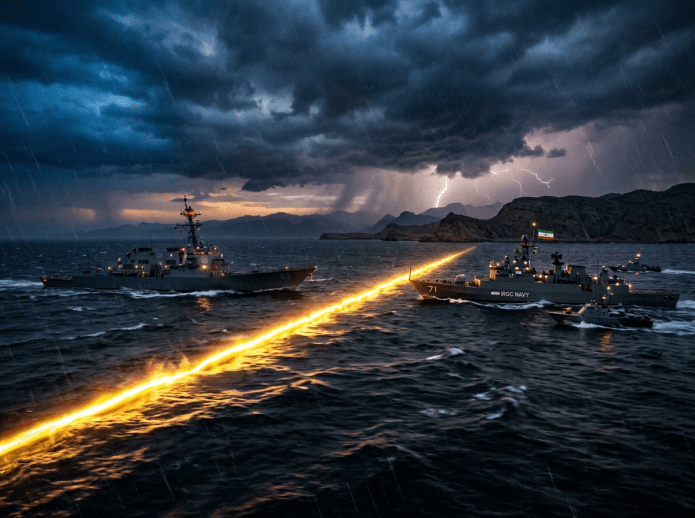
Two warships facing each other with a bright beam between them under dark stormy clouds and lightning

Can a Precarious Ceasefire Still keep the Door Open to Peace? A Risk Management Lens on the US-Iran Negotiations Stalemate

The ceasefire still holds for now. But the logic of war escalation has not been broken.

A few days ago, the two-week ceasefire between the United States and Iran was presented in Washington by Trump with great fanfare as a diplomatic breakthrough, the first step toward de-escalation and perhaps, eventually, peace. The White House narrative was predictable and self-congratulatory: overwhelming pressure had once again created the conditions for diplomacy, proving that force, when applied hard enough, can restore control and deliver a favorable political outcome. The Trump’s formula was familiar. Strike first, raise the cost for the adversary, and then negotiate from a position of restored dominance.

But the promotional wrapping around the ceasefire was quickly torn away by unfolding events. The Islamabad talks ended without agreement, without visible convergence, and without even a next round being scheduled for now. Then came Donald Trump’s declaration that the US Navy would immediately begin a blockade of the Strait of Hormuz. In one move, the meaning of the ceasefire changed fundamentally. A ceasefire with no diplomatic follow-up and a blockade on one of the world’s most sensitive maritime chokepoints is not a peace process. It is not even a stable de-escalation process. It is a more dangerous hybrid condition in which direct strikes are paused while coercive confrontation intensifies through other means. 

Continue reading
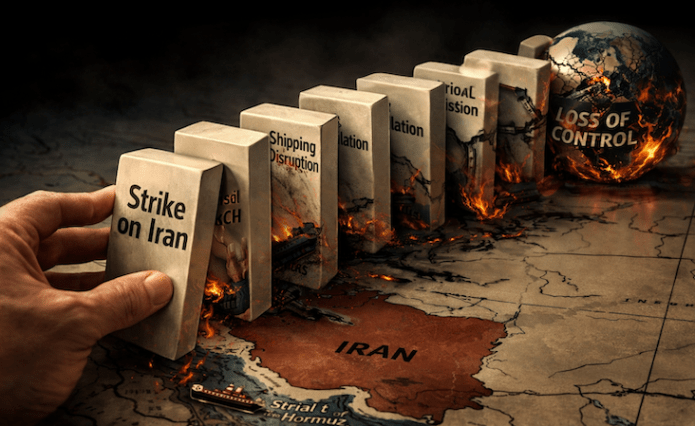
The Iran War Trap: How Strategic Miscalculation is Reshaping the Global Risk Landscape and World Order

Introduction: When Power Meets its Limits

After more than a month of war against Iran, a revealing paradox has emerged. The United States and Israel, two of the most powerful military actors in the world, have demonstrated their overwhelming force and destructive capacity. Yet neither has achieved a decisive strategic outcome. Iran did not break. Under sustained attack and extraordinary pressure, it remains standing, retaliating, adapting and this resistance is increasingly becoming central to the global geopolitical narrative surrounding the conflict. 

What is unfolding in Iran looks more and more like a case study in strategic risk miscalculation and a lesson about how a war launched as a supposedly controlled demonstration of force to gain leverage can quickly degenerate into self-expanding systemic disruptions with mounting spillovers and global unpredictable risks consequences.

Now the central question is no longer whether Washington and Tel Aviv can keep inflicting damage to Iran. Of course they can. The critical issue is whether this war is still strategically winnable on politically acceptable terms and whether the original justification for war was ever sound in the first place.

Now today’s news reports confirms that the conflict has now moved into a precarious two-week ceasefire phase after Trump stepped back from his latest threats, but the core disputes remain unresolved and the truce itself is fragile. 

That matters because this war is no longer just a war. It is a stress test of strategic judgment, use of coercive power, alliance credibility, and global economic resilience.

Continue reading

The ‘Peasant’ Remark: How Not to Negotiate with China – Risk Management Lessons

In the aftermath of the 2025 U.S. tariff escalation, tensions with China have reached a boiling point not just economically with tit-for-tat responses from the Beijing, but also diplomatically and even more deeply in the cultural space. While President Trump’s sweeping tariffs may have been intended to force a global trade reset by pushing world leaders to renegotiate trade agreements seen as unfair by the US administration, recent comments from Vice President J.D. Vance far from encouraging constructive discussions, have on the contrary, added significant fuel to an already volatile fire.

In a high-profile speech, Vance referred to the Chinese as “peasants from whom the U.S. borrow money to buy the goods the chinese peasants manufacture” adding that “it is not a recipe for economic prosperity”.  The reaction from Beijing was immediate and angry. The Chinese Foreign Ministry condemned the remark as “ignorant and impolite.”

Continue reading