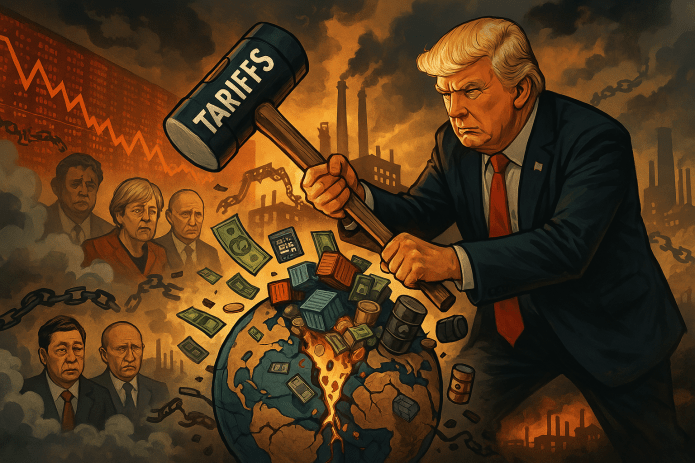
In April 2025, President Donald Trump stunned global markets and diplomatic circles by announcing sweeping tariffs ranging from 10% to nearly 100% on imports from virtually all countries. Dubbed “Liberation Day” tariffs by the U.S. administration, the move triggered an immediate and intense backlash. Politicians, media pundits, and economists around the world denounced the action as reckless, economically unsound, and potentially disastrous for the global economy.
But such a one-dimensional, knee-jerk reaction may itself be dangerously shortsighted. From a risk management perspective, it is precisely in moments like this, when established norms are shaken, that we must resist emotional reactions and instead engage in cool-headed analysis. We need to pause, reflect, and ask deeper questions:
- Why did this happen?
- What underlying risks is the U.S. trying to address?
- Could Trump’s so-called “bulldozer” approach, as abrasive as it may seem, be a calculated disruption deemed necessary to break free from a failing status quo within a constrained timeframe?
Trying to Understand Trump’s Rationale
Let’s identify and analyse the six interconnected structural challenges that appear to form the foundation of the 2025 tariff strategy.
1. Trade Imbalances and Economic Exposure
The U.S. has faced widening trade deficits for decades. In 2024, the deficit reached an eye-watering $1.2 trillion, driven largely by imports from China, the EU, and other trade-heavy economies.
Trade deficits, in and of themselves, are not always harmful. But when persistent and unbalanced, they can:
- Hollow out domestic industries,
- Lead to job destruction and displacement,
- Make a country overly dependent on external actors for essential goods.
Tariffs aim to correct these imbalances by incentivizing domestic consumption and forcing foreign partners to renegotiate trade agreements perceived as unfair by the US. From a strategic risk lens, it’s a way to reduce exposure and regain economic leverage.
2. Dealing with Trade ‘Pirates’
The U.S. administration has, for some time now, accused certain countries, most notably China, of engaging in unfair trade practices. These would include:
- Currency manipulation to keep exports cheap,
- State subsidies to undercut international competitors,
- Forced technology transfers and outright theft of intellectual property,
- Environmental and labor cost dumping (producing goods under lax regulations to drive down costs).
The US administration claims that the problem is not just that these countries are playing dirty, it’s that the rules-based trade system isn’t equipped to stop them. From a risk governance standpoint, this creates systemic moral hazard. Tariffs, therefore, in that context are used as a blunt but potentially potent tool to enforce accountability and reset the rules of engagement.
3. National Security and Supply Chain Resilience
The COVID-19 pandemic and the Ukraine war exposed the fragility of global supply chains. Whether it was personal protective equipment, rare earth metals, pharmaceuticals, or semiconductors, the U.S. found itself alarmingly dependent on foreign, often geopolitical rivals, for critical materials.
Dependence on potentially hostile nations like China for essential goods is not merely inefficient, it is a national security risk.
Tariffs are part of a broader attempt to de-risk these dependencies by reshoring or near-shoring supply chains, especially for strategic industries. It’s a core principle in modern enterprise risk management: diversify critical inputs and ensure operational continuity in crisis scenarios.
4. Domestic Industry Decline
Decades of offshoring have led to the erosion of U.S. manufacturing. Towns across the Rust Belt and Midwest became economic wastelands as factories shuttered and jobs moved overseas.
This decline hasn’t just been economic, it’s societal:
- Community cohesion has dissolved.
- Mental health and addiction crises have escalated.
- Intergenerational poverty has taken hold.
Tariffs are positioned as a shock therapy to reverse this trend. By making offshoring less economically attractive, they aim to trigger the reindustrialization of key sectors, breathing life into devastated regions and restoring local economic ecosystems.
5. Ballooning Public Debt
The U.S. federal debt surpassed $35 trillion in early 2025, with annual interest payments now exceeding $1 trillion, more than the entire military budget. This level of indebtedness is not just fiscally burdensome, it’s unsustainable and destabilizing.
The logic behind the tariffs is partially fiscal: if the U.S. can curb imports, increase domestic production, and tax foreign goods, it could generate revenue and potentially narrow the trade and budget deficits.
While this approach is contested and its long-term effectiveness debated, it represents a clear attempt to re-anchor fiscal sustainability and reduce exposure to foreign creditors.
6. The Erosion of the Middle Class
Perhaps one of the most politically potent justification for tariffs from Trump’s perspective is the plight of the American middle class that voted for him. Over the past three decades:
- Wages stagnated, while the cost of living soared.
- Job security deteriorated.
- Healthcare and housing became unaffordable luxuries for many.
- Retirement savings vanished with each financial crisis.
Entire communities have suffered, while global corporations and elites amassed unprecedented wealth. From a risk equity perspective, this poses a long-term threat to social stability and democracy.
Tariffs are meant to tilt the system back in favor of the working and middle classes by restoring industrial jobs, reducing economic leakage abroad, and stimulating local economies.
The Necessity of a Disruption for a Reset
For years, economists and policymakers have warned that globalization’s current trajectory is unsustainable. But change has been incremental, reactive, and largely symbolic.
Why?
Because the existing system is protected by powerful vested interests, multinational corporations, financial institutions, and political actors who benefit from the status quo. These entities have outsized influence, shaping regulations, trade agreements, and tax structures to favor short-term profits over long-term resilience.
Trump’s strategy, though blunt and highly controversial, reflects a deliberate disruptive approach, a “controlled demolition,” in risk parlance. It seeks to force a reckoning, much like how major corporations sometimes require outside intervention or crisis to break internal resistance to implement necessary change.
Potential Risks and Opportunities
Main Risks
- Trade Wars: Retaliatory tariffs by China, the EU, and others could escalate tensions and hurt exporters.
- Inflation: Higher import costs may raise prices for consumers, potentially fueling inflation.
- Supply Chain Shocks: Industries relying on global components may face cost increases or shortages.
- Market Volatility: Uncertainty can spook investors, cause stock market dips, and slow investment.
- Geopolitical Fragmentation: As trade blocs harden and alliances shift, the world could divide into protectionist camps, potentially undermining global cooperation, worsening conflict risks, and weakening institutions like the WTO.
Opportunities
- Domestic Reindustrialization: Tariffs could make U.S.-made goods more competitive, attracting investment and driving job creation.
- Strategic Autonomy: A self-sufficient economy is more resilient to shocks, be it pandemics, wars, or supply disruptions.
- Balanced Trade & Budget: Reduced deficits may stabilize the U.S. economy and limit its reliance on foreign debt.
- Sustainable Supply Chains: Shorter, more localized supply chains are not only more secure but also often better for the environment.
- Purpose-Driven Trade: Instead of importing everything cheaply, trade could be reoriented toward strategic complementarity, trading only what a country truly lacks or cannot produce competitively.
Conclusion: A Hammer to Crack the Status Quo?
Trump’s tariff strategy may feel like using a hammer to fix a watch, crude, imprecise, and dangerous. Yet perhaps the system wasn’t a fine-tuned watch anymore. Perhaps it was a rigged casino, where the odds were always stacked in favor of a global elite at the expense of workers, communities, and long-term stability.
Viewed through a risk management lens, these tariffs may not just be protectionist impulses. They are a form of strategic disruption, aimed at forcing systemic change in an increasingly fragile and inequitable global economy.
Yes, the risks are real. But the risks of doing nothing, of clinging to a failing model, may be greater still.
As world leaders grapple with this disruption, the responsible response is not to simply condemn and resist or panic and give in. Instead, it is to engage in a strong and honest dialogue:
- How can trade be made fairer and more balanced for all?
- How do we reform global systems that prioritize profits over people?
- How do we ensure that economic growth translates into well-being for all?
The 2025 Trump’s tariffs may be a gamble. But they also represent a wake-up call and an invitation to rethink, rebuild, and renew. Let’s just to that!
 The Risk Management Paradox