Introduction: When Power Meets its Limits
After more than a month of war against Iran, a revealing paradox has emerged. The United States and Israel, two of the most powerful military actors in the world, have demonstrated their overwhelming force and destructive capacity. Yet neither has achieved a decisive strategic outcome. Iran did not break. Under sustained attack and extraordinary pressure, it remains standing, retaliating, adapting and this resistance is increasingly becoming central to the global geopolitical narrative surrounding the conflict.
What is unfolding in Iran looks more and more like a case study in strategic risk miscalculation and a lesson about how a war launched as a supposedly controlled demonstration of force to gain leverage can quickly degenerate into self-expanding systemic disruptions with mounting spillovers and global unpredictable risks consequences.
Now the central question is no longer whether Washington and Tel Aviv can keep inflicting damage to Iran. Of course they can. The critical issue is whether this war is still strategically winnable on politically acceptable terms and whether the original justification for war was ever sound in the first place.
Now today’s news reports confirms that the conflict has now moved into a precarious two-week ceasefire phase after Trump stepped back from his latest threats, but the core disputes remain unresolved and the truce itself is fragile.
That matters because this war is no longer just a war. It is a stress test of strategic judgment, use of coercive power, alliance credibility, and global economic resilience.
The Original Misguided Framing: A Just and Short Preemptive War
The official narrative was familiar: Iran was framed as an intolerable threat to Israel, regional security, and wider stability. The war was sold through the classic grammar of necessity: nuclear containment, preemption threats, deterrence restoration, defense against a dangerous enemy.
But behind that public narrative sat a colder and more opportunistic strategic logic. Washington appears to have concluded that it was facing a narrowing window of opportunity: On the minus side, Israel looked increasingly ready to attack Iran with or without US support, on the plus side, Iran was seen as weakened by sanctions, internal political discontent, and the erosion of parts of its regional network of proxies. The result was the sort of policy temptation that often seduces powerful players: Using the”hammer” approach with the belief that one decisive use of force could solve multiple strategic problems at once.
The implied package deal appears to have been this: strike now, strike hard, and extract maximum gain with minimum commitment. In practical terms, that meant trying to destroy or damage Iran’s nuclear capacity, decapitate its political and military leadership, sharply degrade its regional influence, restore US credibility and deterrence, strengthen leverage over critical energy routes, disrupt broader Eurasian and BRICS realignments and even perhaps trigger regime change more favorable to US interests. That was not irrational. It is opportunistic power politics. But opportunism is not risk strategy, and a window of opportunity is an invitation for troubles without a robust risk-adjusted plan.
The fatal assumption underneath it all was simple: that the Iranian system would not be able to absorb the shock.
That assumption is now the wreckage on which the war rests.
The Illusion of a Short “Shock and Awe” War
The initial theory for action seems clear enough. the war was conceived as a limited shock operation with quick benefits leveraging on Iran perceived weaknesses: Hit fast and hard. Disrupt political and military command. Raise costs of resistance. Demonstrate total dominance. Force Tehran either into capitulation or into negotiations from a position of weakness. Within parts of the Trump-aligned political circles, there also appears to have been a more ambitious hope that Iran’s internal fragility might convert military shock into regime destabilization and change.
That implicit assumption of fragility has obviously failed. Instead, the situation has evolving into something far more dangerous with the war now expanding across the region and affecting the whole world economy with no clear end boundaries as the definition of victory become more inpenetrable.
But this is exactly where proper risk analysis should have been used to stop the momentum. In any serious risk assessment, assumptions must be made explicit, stress-tested, and challenged against alternative scenarios. If the planners did that, they either discounted the downside far too aggressively or assumed that Iran would behave like a weaker and more brittle adversary than it is. If they did not do it, then this is not just strategic error. It is risk governance failure at grand-strategy level.
In risk language, the problem was not just flawed war planning. It was a failure of risk management with no assumptions testing, scenario analysis lacking of discipline, and ignoring second-order consequence analysis.
The Core Strategic Risk Miscalculation: Underestimating Iran’s Resilience and Asymmetric Leverage
The strategic error was not primarily about tactic. It was cognitive. Washington and its allies misread Iran because they projected their own logic onto an adversary operating under a very different strategic and psychological framework. Iran was treated as if it were a near-collapsing economy, a politically brittle regime, an isolated state with poor military capacity, and a desesperate actor that would prioritize cost minimization over endurance. In other words, it was implicitly interpreted through the wrong template: closer to Iraq in 2003 and Venezuela 2026 than to a battle hardened sanctions-era state designed for survival under siege.
Iran is not Iraq or Venezuela. It is a large, resilient state with strategic depth, significant missile and drone capacity, long experience operating under sanctions, ideological cohesion and an entire security doctrine built around asymmetry, dispersal, redundancy, and endurance. Its mountainuous geography also favors defense and raises the cost of direct invasion. And experts agree that external attack tends not to dissolve internal cohesion in such systems. More often, it hardens it.
This is the strategic asymmetry that matters most: the United States entered the war looking for a quick victory; Iran responded to it trying to deny one. That is not a small difference. Iran does not need to win the war conventionally. It only needs to endure to prove that America and Israel cannot win it on their preferred timetable and terms. That is a much lower and more achievable threshold.
The Geography of Leverage: Why This War Could Never Stay Local
But this is not just about prepardness and resilience. One of the most underestimated factors in this war is Iran’s geography. Iran sits on one of the most critical chokepoints in the global system: the Strait of Hormuz through which roughly one-fifth of global oil passes.
This position gives Iran asymmetric leverage far beyond its conventional military balance. It cannot defeat the United States militarily. But it can threaten the arteries of the global system on which both the world economy and US power projection depend. During this war, Iran has been using disruptions in Hormuz not necessarily through a simple total closure, but through selective attacks and control creating a level of uncertainty severe enough to block shipping flows, remove major volumes from the market, send costs soaring around the world and lead politicians to panic.
That is a crucial point often missed in shallow commentary we read online. Modern economic systems do not require total disruption to suffer major consequences. They require only enough uncertainty around critical nodes. Fear, insurance premiums cost, rerouting costs, delayed deliveries, volatility in energy markets, inflation return and scarcity expectations can do much of the work amplifying the damages.
That is also why this conflict cannot be analyzed only through missile exchanges and material damages maps. The real battlespace now includes sea lanes, insurance markets, inflation trajectories, alliance politics, and the psychology of investors and consumers.
That is how a regional war becomes a global economic risk event.
News reporting this week confirms that the strait has become central to the crisis development, to diplomatic efforts, and to the temporary ceasefire itself. Iran has reportedly agreed to permit passage during the truce but under its own military oversight, while insisting on broader political conditions and preserving its leverage for negotiations.
From a Singular Linear War Event to a Self-expanding Risk System
This conflict was supposed to be bounded into a single conflict theater. It is now behaving like a complex risk system with reinforcing feedback loops.
Military strikes generate retaliation. Retaliation widens the battlespace. Wider battlespace creates economic stress. Economic stress increases political pressure. Political pressure drives new ultimatums. Ultimatums make diplomacy less credible. Reduced diplomatic credibility increases the probability of further escalation.
That is not a battlefield dynamic. That is a systemic escalation dynamic.
The risk is no longer confined to Iran, Israel, or even the Gulf. It now touches shipping, energy, inflation, food prices, alliance politics trust, UN paralysis, investor sentiment, and recession risk. News coverage shows oil prices surging and markets reacting sharply to the widening threat environment. Markets reacted immediately to the ceasefire announcement: Asian equities jumped and oil prices dropped sharply, which tells us something important. The system was not pricing peace. It was pricing catastrophe risk.
That is the deeper lesson. Once a war becomes a system, no actor fully controls it, not even the one that triggered it.
The Role of Israel: Tactical Logic, Strategic Exposure
Israel’s rationale is not difficult to understand, even if one rejects it. Its national security doctrine has long emphasized prevention, escalation dominance, and the neutralization of emerging existential threats before they fully mature. From that standpoint, acting against Iran is not viewed as optional. It is viewed as necessary.
Domestic politics also matter and reinforce that logic. Prolonged war environments tend to reinforce securitized politics, consolidate hardline coalitions, marginalize dissent, and enable leaders under pressure to govern through emergency logic. That does not mean every Israeli decision is reducible to Netanyahu’s political survival. But it would be naive to pretend internal political incentives are irrelevant in this case.
The deeper problem is that tactical logic does not automatically translate into strategic success. Israel may successfully degrade Iranian capabilities while simultaneously counterproductively legitimizing Iranian retaliation narratives, increasing regional hatred, hardening adversaries, and spreading instability across the region by normalizing a wider war logic. That is the paradox.
A war campaign can be tactically successful and strategically self-damaging at the same time.
Israel may be winning tactical strikes while at the same time damaging its position and worsening the long-term risk environment in which it must live.
That is one of the most dangerous illusions in modern security policy: confusing immediate operational success with durable strategic advantage.
America’s Strategic Dilemma: Power Without a Winning Endgame
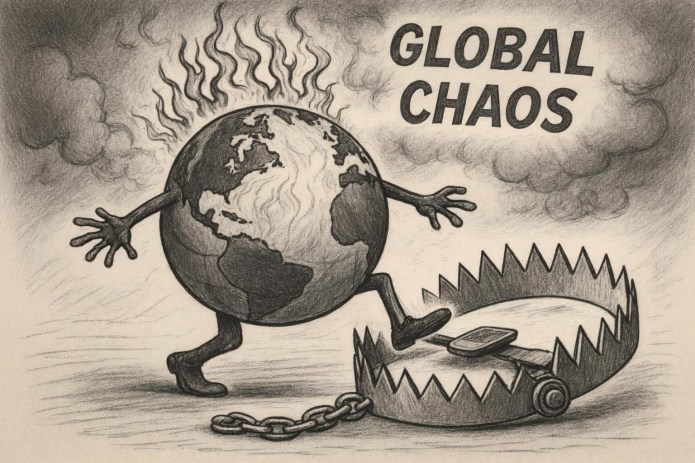
The United States now faces the trap it set for itself.
Trump’s worldview is openly transactional. It is less about providing balanced order than extracting advantage. In that model, power is used to maximize gain while minimizing responsibility, cost, and long-term entanglement. That can work in low-resistance settings. It becomes much more dangerous in a conflict where the adversary is built for endurance and where global systems are highly interdependent.
This is why Iran became such a dangerous test case. If Trump wants to project a new doctrine of unconstrained coercive power, then ambiguity is fatal. The war must seem to end in visible, undeniable, politically legible success.
But that is precisely what the current structure of the conflict makes so difficult.
Trump’s recent rhetoric exposes the dilemma starkly. In recent days he escalated from repeated deadlines to sweeping threats against Iranian infrastructure, including power plants, bridges, and oil facilities. News outlets reported his most extreme formulation as a threat that “a whole civilization will die tonight” if Iran did not comply. Then came the shock reversal: a two-week ceasefire, reported engagement with at least parts of Iran’s 10 points proposal, and a pause in major escalations. Yet News reports also notes that Trump later disparaged elements of the Iranian plan, while all sides continue to issue contradictory interpretations of what has actually been agreed.
This is not strategic clarity. It is strategic whiplash.
The immediate takeaway is not that peace is at hand. It is that Washington appears to have discovered the cost of its own escalation ladder. The two-week ceasefire is best understood not as resolution, but as a pause within a larger unresolved risk structure. It reduces immediate catastrophic risk, but it also creates a fresh layer of uncertainty: what happens if talks fail, if terms are contested, or if either side uses the pause to reset its position?
Why the War Did Not Go According to Plan
They overestimated the shock effect. They underestimated Iran’s absorptive capacity. They mistook sanctions fatigue for regime fragility. They assumed deterrence could be restored by demonstration rather than by sustainable political architecture. They treated a complex adaptive conflict as if it were a linear force-to-result transaction.
They also underestimated the regionalization of risk. Iran is not an isolated battlefield. It has partners, influence channels, and the ability to spread pressure laterally. A concentrated war can sometimes be won. A dispersed war is much harder. It taxes logistics, alliance cohesion, domestic patience, escalation control, and macroeconomic resilience all at once.
This is precisely where risk management thinking matters. Disciplined risk analysis does not ask only, “Can we strike?” It asks, “What assumptions are we making? How do they fail under stress? What second-order and third-order effects emerge if the target does not behave as expected? What are the tail risks? What is the exit path?”
Those questions do not appear to have shaped the opening logic of this war nearly enough.
A Better Way to Think About Winners and Losers
The usual question, “Who is winning?” is analytically lazy.
The better question is: who is accumulating risk, who is redistributing it, and who is converting pain into leverage?
In the short run, Iran has clearly gained narrative advantage. Its communication operations, state media, and symbolic messaging have turned endurance into legitimacy. Across much of the non-Western world, the war is increasingly interpreted through the lens of aggression, hypocrisy, and double standards. At a result, the United States has accumulated reputational risk, and Israel has accumulated strategic exposure even where it has scored some tactical advantages.
In the medium term, however, the picture becomes harsher for Tehran. Narrative advantage does not repair shattered infrastructure. Communication victory does not restore a damaged economy. Iran may be winning the narrative phase while weakening its long-term structural base.
That is the Iranian paradox. Stronger politically in the immediate sense. Weaker structurally over time.
The same paradox applies elsewhere. The US may still dominate in military power while losing control over outcomes. Israel may be damaging enemies while hardening the region against itself. And the global economic system may prove to be the biggest loser of all, because its interdependencies are now being weaponised in plain sight.
Scenario Analysis: A Connected Risk Pathway, Not a Set of Isolated Boxes
A serious scenario risk analysis should not treat scenarios as separate compartments. They are connected pathways. One flows into another depending on triggers, failures, and choices.
The most dangerous mistake in scenario work is to imagine that scenarios are alternatives sitting politely side by side. In reality, conflicts like this move through transition points. A ceasefire can fail and slide into attrition. Attrition can trigger wider escalation. Wider escalation can increase internal political stress. Diplomatic openings can freeze escalation and create a bridge to settlement. A black swan can erupt inside any of those pathways.
So the question is not just “Which scenario occurs?” It is “What conditions make movement from one scenario to another more likely?”
Here is the current logic chain.
Scenario 1: Accelerating Regional Escalation
This is the most dangerous near-term pathway if the ceasefire collapses. Trump’s ultimatum politics, unresolved disputes over Hormuz, continued distrust, and competing interpretations of the truce all mean that the war could rapidly return to a larger strike cycle. If the US and Israel intensify attacks on infrastructure, Iran is likely to retaliate across regional energy, water, port, and logistics systems, while aligned actors widen pressure elsewhere. That would create the conditions for a severe energy and shipping shock leading to a global recession.
How it connects: Scenario 1 is the main failure pathway out of the current ceasefire. If diplomacy stalls or the truce breaks down, this is where the system can move fast.
Scenario 2: Prolonged Attrition
This remains the plausible baseline if no one achieves decisive advantage and no durable agreement emerges. The war settles into a grinding pattern of strikes, retaliation, sanctions, maritime disruption, and political signaling. Not dramatic enough to force resolution. Damaging enough to steadily corrode resilience on all sides.
How it connects: Scenario 1 can cool into Scenario 2 if escalation becomes costly. Scenario 3 can also decay into Scenario 2 if the ceasefire holds formally but underlying hostility continues through lower-intensity means.
Scenario 3: Unilateral De-escalation Without Resolution
This is the scenario now partially unfolding. Trump’s two-week ceasefire move appears to be a tactical de-escalation after a period of extreme rhetoric, and reporting suggests it may involve at least partial engagement with Iran’s negotiating framework. But the arrangement is narrow, short, disputed, and reversible. The parties have not resolved the core issues. They have merely paused the immediate slide toward wider catastrophe.
How it connects: Scenario 3 is the current bridge scenario. It can lead upward toward Scenario 5 if middle powers and mediators create enough structure and trust. Or it can slide back into Scenario 2 or Scenario 1 if talks fail, if terms are reinterpreted, or if a provocation restarts escalation.
Scenario 4: Iranian Internal Stress Fracture
This is the medium-term deterioration scenario many US and Israeli hawks still hope for. Iran survives the immediate war but emerges with degraded infrastructure, tighter economic stress, higher elite tension, and rising social strain. Over time that can create internal instability, though not necessarily collapse. Fragility is not failure. Many regimes survive far longer than outsiders expect.
How it connects: Scenario 2 makes Scenario 4 more likely over time. Scenario 3 can also feed Scenario 4 if the ceasefire merely freezes military escalation while sanctions and internal pressures continue to accumulate.
Scenario 5: Managed De-escalation and Diplomatic Settlement
This is the best outcome for the region and for the world, but still not the most likely. It would require the current ceasefire opening to mature into structured negotiation supported by credible mediators and outside guarantors. The fact that Trump has stepped back from his latest ultimatum and that some space for talks appears to have opened means this scenario is no longer abstract. But it remains fragile because the gap between a temporary pause and a durable settlement is enormous.
How it connects: Scenario 5 is the upward path out of Scenario 3. It depends on whether the truce becomes architecture rather than theater.
Scenario 6: Limited Nuclear Strike, Low Probability but Intolerably High Impact
This is the black swan scenario that serious risk analysis cannot ignore. Its probability is thankfully very low. But low probability is not the same thing as negligible importance. The history of human disasters is full of catastrophes that elites dismissed because they seemed too extreme, too irrational, or too dangerous to contemplate. That is precisely why they were not prevented.
The reason to include this scenario is not sensationalism. It is responsibility.
There is a deeply worrying trend in strategic discourse in several nuclear-armed states: the normalization of arguments that limited use of smaller nuclear weapons could produce operational advantage without triggering full-scale nuclear war. This discourse has surfaced for years among certain analysts and political voices, and the fact that such thinking continues to circulate at high levels should alarm anyone serious about risk governance. In the current context, where Trump’s rhetoric has become increasingly erratic and extreme, it would be reckless to assume that the taboo against limited nuclear use is politically untouchable forever. Recent coverage of his threats against Iranian civilization and critical civilian infrastructure only reinforces concern about volatility and judgment.
A limited nuclear strike would not produce a “contained advantage.” It would shatter the nuclear taboo, legitimize imitation, accelerate proliferation incentives, deepen global fear, and make the world far more dangerous for everyone.
How it connects: Scenario 6 can branch out of Scenario 1 if escalation control collapses and leaders embrace catastrophic thinking under pressure. It is not the base case. It is the unacceptable tail risk that should require discipline policy from around the world.
Conclusion: The Failure is Not Military. It is Strategic and Political
The defining failure of this war was not a battlefield error. It was a failure of strategic risk management.
The US and Israel assumed that superior force would generate rapid political clarity. Instead, it generated systemic ambiguity. They assumed Iran was weak in the sense that mattered to them. It was weak materially, but resilient structurally and politically. They assumed the war would stay bounded. It did not, because critical systems do not stay insulated once chokepoints, alliance credibility, regional actors, and economic interdependence are exposed and weaponised.
The hardest truth in this crisis may be the simplest:
Washington and Tel Aviv launched a war as an control instrument, instead it became a risk system, and systems do not obey the intentions of the actors who trigger them.
That is why this war matters far beyond Iran. It is exposing the limits of brute force in a tightly integrated and interdependent world. Even the strongest powers can still win in the battle tactic but lose the war logic.
It is forcing everyone else to confront an uncomfortable and sobering truth: the old order is dying and a new one is emerging accelerating fragmentation and magnifying global economic and political vulnerabilities as exposed by this war.
Now the two-week ceasefire creates a narrow opening for a constructive peaceful resolution. It may become the bridge to a diplomatic off-ramp. It may also prove to be only a pause before the next round of escalation. That is why this moment is not a resolution. It is a critical decision point of where to go. Risk is not knowing what we are doing. We better work on this!
 The Risk Management Paradox