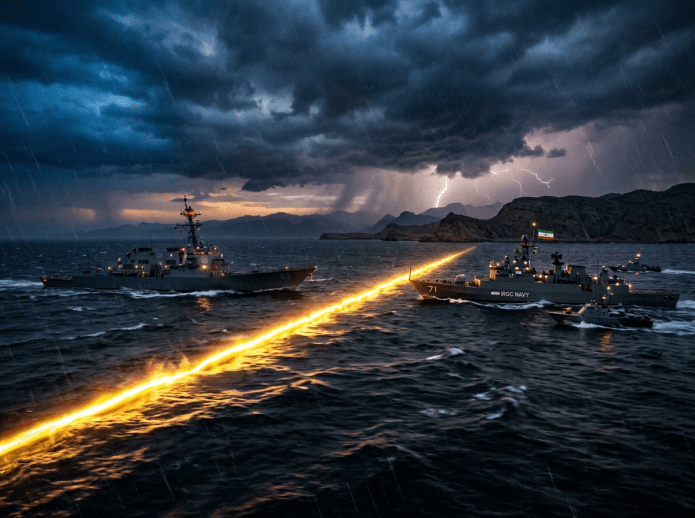
The ceasefire still holds for now. But the logic of war escalation has not been broken.
A few days ago, the two-week ceasefire between the United States and Iran was presented in Washington by Trump with great fanfare as a diplomatic breakthrough, the first step toward de-escalation and perhaps, eventually, peace. The White House narrative was predictable and self-congratulatory: overwhelming pressure had once again created the conditions for diplomacy, proving that force, when applied hard enough, can restore control and deliver a favorable political outcome. The Trump’s formula was familiar. Strike first, raise the cost for the adversary, and then negotiate from a position of restored dominance.
But the promotional wrapping around the ceasefire was quickly torn away by unfolding events. The Islamabad talks ended without agreement, without visible convergence, and without even a next round being scheduled for now. Then came Donald Trump’s declaration that the US Navy would immediately begin a blockade of the Strait of Hormuz. In one move, the meaning of the ceasefire changed fundamentally. A ceasefire with no diplomatic follow-up and a blockade on one of the world’s most sensitive maritime chokepoints is not a peace process. It is not even a stable de-escalation process. It is a more dangerous hybrid condition in which direct strikes are paused while coercive confrontation intensifies through other means.
That is the first lesson from a risk management perspective. Too many observers confuse a temporary reduction in visible violence with a genuine reduction in underlying risk. But ceasefires do not resolve conflicts by themselves. They merely freeze one mode of escalation while the parties reassess leverage, losses, red lines, and plan for their next moves. In that sense, the current pause increasingly looks like a temporary risk-control mechanism inserted into a conflict that had become too dangerous, too costly, and too politically toxic to continue on exactly the same trajectory. The fact that talks took place in Islamabad still matters. It proves that the conflict has not yet crossed the line beyond which diplomacy becomes impossible. But no serious analyst should have expected a war of this scale, after this level of bloodshed and distrust, to be politically resolved in a single meeting. That was note realistic. The problem is not that the meeting failed. The problem is that this meeting was a the first serious test of diplomacy and it has already exposed how fragile the ceasefire really is.
Many analysts are now wondering how long the ceasefire can hold. But the more important question is whether this precarious ceasefire can still become a pathway to peace even after the first diplomatic effort has stalled and new coercive pressure has been openly escalated by Washington. My answer is a cautious yes. But only if we are clear that the odds of success have worsened sharply, and only if we are equally clear about what kind of negotiation this really is, what risks are embedded inside it, and what would be required to turn it into something more stable than a tactical pause before the next wave of confrontation.
Why the ceasefire pause happened
To understand the talks, one must first understand why both sides accepted the ceasefire in the first place after weeks of threats, ultimatums, and escalating violence.
Washington backed off because the war was not delivering the clean strategic returns that Netanyahu and the more hawkish circles around Trump had hoped for. Iran had not collapsed. There was no regime change. Tehran had not capitulated. It had not become a defeated and passive object of American will. Instead, it absorbed the blows, retaliated, raised the cost of a continued war, and, above all, used the Strait of Hormuz to transform a regional military confrontation into a systemic global economic and political crisis. That point is critical. The fact that the ceasefire was explicitly linked to safe passage through Hormuz reveals where the real leverage sat when Trump suddenly pivoted from ultimatums to diplomacy.
Trump was also under growing domestic and international pressure. A war sold as a short display of strength is politically manageable. A war that begins to look like an open-ended liability is something else entirely. Oil and shipping risks, nervous markets, possible casualties, allied unease, the prospect of renewed inflation, and the fear of another Middle East entanglement all threatened to turn continued escalation into a political disaster for Trump, especially with domestic political time already narrowing. Washington’s urgency was not simply military, it was legal, political, and economic. The longer the war drags on without congressional consensus, allied unity, or a clear strategic result, the narrower the White House corridor of maneuver becomes. That matters because once one side knows the other is under domestic political time pressure, the incentive to make concessions falls rather than rises. Therefore the sudden pivot from ultimatums to talks was not the gesture of a confident victorious party. It looked much more like an administration trying to regain strategic room for manoeuvering before the situation it created worsened beyond control.
Tehran for its part accepted the ceasefire for a different reason. By resisting the military onslaught, it had proved its resilience, but resilience is not immunity. The reality is that The war inflicted tremendous damage to the country. Iran’s military assets were hit repeatedly, infrastructure was damaged, the population was placed under acute physical and psychological strain, and the risk of intensified bombardment was a sobering reality. Since Tehran had demonstrated that it could not be quickly broken, it also had every reason to now convert that political success into a negotiation phase before the cumulative damage from the war became harder to absorb. In other words, Iran accepted the pause not because it had been defeated, but because it had already achieved something politically important: It had denied the quick victory the US and Israel were seeking and was able to enter talks without capitulation with a position of relative leverage. Furthermore Iran wanted to show to world its willingness to negotiate to prevent the US from framing and blaming them as the obstacle to peace.
That is the paradox. Both sides stepped into the diplomatic pathway because continuing the war had become too dangerous and costly for them. But they did so from very different narratives and rationale about what the pause means. That divergence helps explain why the Islamabad talks were always going to be extraordinarily difficult.
Why the Islamabad talks failed
The easiest explanation is that the parties’ positions were simply too far apart and irreconciliable. That is true, but not sufficient to understand what is really going on.
The deeper reason the talks failed is that Washington and Tehran were not merely bargaining over the technical terms of peace. They were bargaining over the political meaning of the war itself. The American side, led by Vice President J.D. Vance, wanted an agreement that could be presented as proof that the US coercion approach had worked and restored deterrence. Iran, led by Parliament Speaker Mohammad Bagher Ghalibaf, wanted something very different with the recognition that it had not been broken and that the negotiation would not amount to capitulation disguised as diplomacy.
So Iran came with demands for reparations, asset relief, recognition of interests, and broader de-escalation. The US came with demands on non-proliferation, nuclear constraints, and freedom of navigation. The two sides were not yet looking for common meeting grounds for peace, they were staking out the outer limits of what they would refuse to surrender. This was be fine as a starting position in a negotiation process, but, unfortunately, the discussions did not move beyond that point. That is why the meeting failed.
There is also a deeper structural reason for the failure: The TRUST problem. Trust between the US and Iran is not merely low. It is close to nonexistent. Tehran does not believe that Washington negotiates in good faith independently from the use coercion. On its side, Washington also simply does not believe that Tehran can be trusted and think that its government will only respect the language of force. And once Trump’s team started speaking again in the language of “final offers,” the whole diplomatic process took on the character of an ultimatum dressed up as negotiation. From Tehran’s perspective, that was confirmation that diplomacy remained subordinate to coercion.
That is why these talks and this whole negotiation process should not be confused with conventional peace diplomacy. They are asymmetric bargaining under duress.
Conventional peace diplomacy vs bargaining under duress
It is a mistake to imagine these talks as a normal peace process in which two antagonistic sides, having recognized the costs of war, begin gradually taking reciprocal steps to build trust and search for a workable compromise. Nothing in the structure of this negotiation supports that reading.
A real peace process requires at least some minimal shared understanding that peace is now more beneficial than continued confrontation. That common understanding is not yet visible here. What we see instead is a deeply asymmetric bargaining situation. The United States retains overwhelming technological and military superiority, but has failed to convert that superiority into decisive political submission. Iran has been heavily damaged, but it has also proved that it cannot simply be bombed into surrender on demand. That leaves Washington in an uncomfortable and dangerous position: strong enough to escalate, but not strong enough to guarantee the political result it wants at an acceptable cost.
As a result, the US appears to be doing something narrower than peacemaking. It seems to be trying to manage escalation while keeping maximum pressure alive. Tehran, meanwhile, is trying to prevent the ceasefire from becoming merely a softer stage in a longer strangulation campaign. That distinction matters enormously. Negotiations fail when one side believes it is discussing the conditions for peace while the other is effectively discussing the terms of submission and compliance management.
Iranian caution is therefore not irrational. Previous attacks in the midst of negotiations, Targeted killings of its leadership, continuous bombing, threats to infrastructure, economic sanctions, and now a blockade announcement give Tehran every reason to believe that Washington cannot be trusted because it pursues a coercion first and peace second agenda. At the same time, Washington also has reason to suspect that Iran may use the pause to consolidate its position internally, preserve its leverage over Hormuz, and wait for American political cohesion to weaken. Neither side trusts the other’s intent. So this is not yet a trust-building process. It is a contest over who can better survive, shape, and exploit the pause for its own benefit.
The blockade changes everything
Trump’s blockade announcement is strategically important because it transforms the ceasefire’s meaning. A blockade is not diplomacy. It is force projection by other means. It does not reopen a path to peace; it narrows it unless it is carefully reversed or folded into a negotiated mechanism to reopen the strait of hormuz. In practical terms, the underlying message for Tehran is: “we may pause direct strikes for now, but we reserve the right to intensify pressure through maritime and economic strangulation until you accept our terms because we are strong and you are weak”.
That is why the current moment should be described not as a peace process, but as a negotiation under siege conditions. It is a high risk level game of cards!
From a risk perspective, this is an extremely unstable configuration. A blockade around Hormuz raises the probability of military incidents at sea, miscalculation, shipping and insurance shocks, wider market volatility, and sharp political pressure on third-party states that depend on Gulf energy flows. It also increases the risk that the ceasefire will not collapse through a deliberate strategic choice, but through an incident that neither side initially intended to make decisive. This is precisely how a fragile coercive equilibrium break down.
In other words, the ceasefire has not yet moved the conflict out of the danger zone. The blockade is actually pulling it back toward it.
Why Washington may actually prefer force to peace
Publicly, Washington’s narrative presents Iran as the destabilizing force in the region and the main obstacle to security and prosperity. In that framing, the blockade after failed talks looks like the natural continuation of “peace through strength”: apply more pressure and Iran will eventually be forced to accept peace on American terms.
One can read this as a simplistic worldview, especially given Trump’s well-known preference for threat inflation, theatrical ultimatums, and transactional thinking. But there is a darker and more serious possible interpretation that should not be ignored.
It is entirely possible that parts of the US establishment do not actually want a full conflict resolution in the Middle East if a certain level of managed instability serves its broader strategic and financial interests better. A region kept divided, insecure, and dependent is easier to influence than one that becomes more politically autonomous, economically balanced, and strategically self-organizing. This does not mean Washington wants complete chaos. It means it may prefer a regional order in which no rival powers, whether Iran, a more independent Gulf bloc, Russia through north-south corridors, or China through Eurasian “silk roads” infrastructure, can stabilize the environment independently of American power.
From that perspective, diplomacy for the US becomes less about creating the conditions for peace and more about risk-managing the costs of continued pressure and low level instability: keeping Iran constrained, preserving maritime dominance, limiting domestic political blowback, keeping rivals at bay, and avoiding the full political toxicity of another visible forever war. This is where using a risk lens is especially important to reframe our understanding of complex situations and uncover possible hidden agendas of the parties involved.
Great powers do not always seek peace if disorder itself helps preserve dependency towards them.
That is also why Israel’s role must be confronted directly and without euphemism. Israel is not a passive bystander dragged reluctantly into this confrontation. It has been a decisive driver for war, a key advocate of attacking Iran, always pushing for escalation and it continues to benefit politically and strategically from keeping pressure high on Iran and on connected fronts, especially in Lebanon. Israel’s government under Netanyahu has shown no real interest in a genuine stable compromise that would normalize US-Iran relations or reduce the rationale for permanent regional securitization by the US. On the contrary, it is a fact that through the past 70 years, continued instability in the region has helped preserve Israeli strategic centrality in world and US politics. This conflict with Iran follows the same logic as it justifies ongoing US funding, promotes hardline expansion policies, and keeps attention fragmented across multiple fronts from Gaza to Lebanon and Yemen. The current spotlight on Lebanon is not a side show. If Lebanon remains outside the effective logic of any ceasefire and Israeli military action there continues, then one of the most destabilizing channels of renewed escalation remains fully open. In that case the war has not ended. It has merely been somewhat compartmentalized.
This is why other world leaders in China, India, Russia and in Europe cannot afford the luxury of diplomatic passivity with a looming world economic crisis. If they genuinely want peace, they must stop treating Trump’s ultimatums as the natural center of gravity and begin collectively resisting the normalization of coercive improvisation as a substitute for real diplomacy.
Why Tehran still has reason to negotiate for peace
Iran accepted the ceasefire because, although it survived and gained politically, it remains in a precarious position that is likely to deteriorate over time if the conflict simply drags on. The war inflicted substantial damage. Continuing open confrontation with the US and Israel carries obvious military, economic, and social costs. So Tehran has real incentives to turn battlefield resilience into negotiated gains while it still retains leverage. Furthermore it wanted to demonstrate that Iran is not the obstacle to peace.
But Iran’s negotiation logic is not surrender. It is conversion. Tehran wants to convert survival into guarantees against renewed attack, recognition that coercion failed to break it, relief from sanctions and strangulation pressures, and preservation of the deterrent capabilities that make future coercion costly. That is why the Iranian side is likely to negotiate seriously and even make meaningful compromises within limits. But it also knows that if it gives away too much, especially on sovereignty and deterrence, it risks turning a political success into a strategic trap.
The US seems to be confusing Iran’s willingness to discuss terms with willingness to accept full disarmament by stages. That is not going to happen.
A risk map of the two sides
From a risk management perspective, the two parties have different objective functions, different time horizons, and different tolerances for uncertainty and loss.
The United States wants several things at once. It wants maritime security restored, or rather control restored in a form compatible with American dominance. It wants to reduce the immediate systemic danger linked to Hormuz. It wants to avoid a long war that becomes politically toxic at home. It wants to preserve the image that coercive pressure still works. But it also likely wants to retain enough ambiguity and operational freedom to resume pressure later if needed. That creates a structural temptation to negotiate not primarily for peace, but for escalation management under favorable optics.
Iran, by contrast, is negotiating under continuous threat: the threat of renewed bombing, targeted killings of leaders and negotiators, of economic strangulation, and of being forced to agree staged concessions designed to hollow out its deterrence capacity. This is why the Libyan precedent still matters psychologically even if the cases are not identical. It reminds any targeted state that surrendering core souvereingty and deterrence capabilities in exchange for Western normalization can end in strategic vulnerability rather than security.
Iran’s minimum requirement, therefore, is not goodwill. It is credible protection against a hollow peace trap. Any serious Iranian negotiator will treat missiles, drones, strategic depth, and sovereign enrichment capacity not as casual bargaining chips but as pillars of long-term deterrence. Tehran may compromise on procedures, sequencing, verification, or phased implementation. But if it concludes that peace means disarmament without protection and economic restauration, then it will logically conclude that peace is simply coercion in a softer language.
Third parties matter more now, not less
The failure of the first talks does not prove mediation is useless. It proves mediation is more necessary than ever because trust between the primary parties is near zero.
Pakistan’s role matters because it offers a trusted buffer, a politically usable venue, and a non-Western setting that both sides can enter without symbolically surrendering to the other’s frame. The involvement or interest of actors such as Saudi Arabia, Qatar, Egypt, China, Russia, and European states also confirms that this is no longer merely a bilateral confrontation. The spillovers of the war and of the talks failure are too large. The world economy, shipping routes, energy prices, and regional security all sit too close to the burning fire.
The Gulf states have even more at stake because they are directly exposed. Saudi Arabia, Qatar, Kuwait, and the UAE do not want a blockade-to-escalation cycle that turns ports, bases, desalination facilities, pipelines, and trade corridors into targets or shock absorbers for a war they did not start and do not control. Europe wants de-escalation because it cannot afford another energy shock hitting already weakened economies. Russia and China may gain strategically from visible evidence that American coercive power has limits, but neither benefits from uncontrolled chaos around one of the central arteries of global trade.
This is precisely why external leaders from the whole world starting with China, India, Russia, Turkey and even Europe, should stand up to Trump firmly but intelligently. Not through theatrical denunciation of the war alone, but through coordinated practical pressure to push a new peace architecture. That means, at minimum, demanding an immediate freeze on new coercive escalations during talks, opposing any unilateral blockade regime from both Iran and the US, insisting on a rapid diplomatic re-entry point with a fixed next round of talks, backing a phased step-for-step framework focused first on maritime safety and non-renewal of strikes, supporting credible third-party monitoring and guarantees, and making it unmistakably clear that continued compartmentalized Israeli escalation in Lebanon or elsewhere is incompatible with any serious regional settlement. The world does not need more statements of concern. It needs an organized coalition for de-escalation with concrete conditions, timelines, and consequences for spoiler actors.
The key negotiation risks now
A risk lens adds value precisely because it shows where the process can fail even while all sides still speak the language of diplomacy.
The first risk is ceasefire collapse risk. The blockade itself raises the chance of incident, confrontation, retaliation, or reinterpretation.
The second is sequencing risk. With no deal and no new talks scheduled, there is no agreed order for moving from ceasefire to a wider settlement.
The third is misinterpretation risk. Washington presents the ceasefire as proof that pressure works. Tehran sees it as the fruit of endurance. Those are incompatible psychological foundations.
The fourth is spoiler risk. An Israeli strike in Lebanon, a maritime clash, or a militia action could rapidly reset the escalation ladder by transforming the political climate overnight.
The fifth is symbolic political risk. Trump does not want to look weak after failed talks. Iranian leaders must show they did not surrender after everything the country endured. Symbolic pressure makes negotiation harder, not easier.
The sixth is systemic economic risk. If Hormuz remains a contested battlefield in maritime and financial terms, the global economy is pulled directly inside the conflict. That could finally force other world powers to intervene forcefully diplomatically, but it can also harden positions and accelerate the fragmentation of the geopolitical landscape.
Can this precarious ceasefire still lead to peace?
Yes, but only if the logic of the negotiation changes, especially on the American side. A real pathway to peace should be diplomatically pushed by a coalition of world leaders through various channels and would now require at least five things.
First, an immediate stop to coercive escalations that change facts on the ground while talks are paused. A blockade moves in the opposite direction.
Second, a clear diplomatic re-entry point. Right now, the absence of a scheduled next round is itself a major risk.
Third, credible sequencing with reciprocity. Not vague promises. Not an attempt to solve Hormuz, sanctions, missiles, the nuclear issue, Lebanon, and regional posture all at once. That almost guarantees deadlock. Start narrower, with reciprocal movement that both sides can verify.
Fourth, credible third-party guarantees and verification on essential issues. Neither side will make major concessions or surrender leverage on the basis of goodwill alone.
Fifth, an outcome that both sides can narrate as a victory or at least a beneficial non-surrender. Deals fail not only because interests diverge too widely, but because leaders cannot politically survive the optics of defeat.
Without those conditions, the ceasefire is more likely to become one of three things: a short pause before renewed escalation, a slide into low-grade attrition, or a deceptive interim arrangement in which conflict continues under new forms.
Scenario logic: how the pathways now connect
The current condition is best understood as ceasefire plus stalemate plus blockade pressure. This is not an end-state. It is a bridge toward a new phase of the conflict.
One path leads downward toward renewed war. Talks fail definitively, one side accuses the other of bad faith, and a blockade incident, strike, provocation, or front expansion resets the escalation ladder. In that case the ceasefire will be remembered not as the beginning of peace, but as a short operational pause between two phases of the same war.
A second path leads sideways. The ceasefire holds partially, talks eventually resume, but no real settlement emerges. The conflict mutates into managed hostility and chronic instability.
A third path still exists upward. Third-party mediation helps reopen talks, the blockade is suspended or folded into a monitored framework, and the parties move toward a narrower agreement focused first on maritime security and non-renewal of strikes before expanding the agenda.
That third path is still possible. But after the failure in Islamabad and the subsequent blockade announcement, it is no longer the natural next step. It is the path that must now be deliberately rebuilt through proactive actions from the world community.
Conclusion
Even a precarious ceasefire can still keep the door open to peace because it lowers immediate catastrophe risk and preserves some diplomatic space.
But right now, the negotiation is stalled because the parties are still trying to impose the meaning of the war rather than agree on the conditions of peace. Washington wants a settlement that proves force works. Tehran wants a settlement that proves force failed to break it. Washington wants order restored on its terms. Tehran wants its survival and sovereignty recognized as facts that cannot be bombed away. Those positions remain fundamentally incompatible.
That is why the blockade is so dangerous. It signals that the United States is still trying to negotiate from pressure dominance even after the first direct talks failed. That may generate leverage. It may also destroy the little diplomatic space that still exists.
So can this ceasefire still become a real path to peace?
Yes, but only if the parties stop treating negotiation as a continuation of war by other means, and only if credible mediators and world leaders finally stop indulging Trump’s coercive volatility and instead build a negotiation architecture that reduces fear, clarifies sequencing, restrains spoilers, and makes restraint more credible than escalation.
That is a high bar. But it is still lower than the cost of allowing this war to slip back into a hot destructive phase that will inevitably affect everyone.

