show the link between nutrition and chronic diseases

Confronting the Looming Global Health Crisis: A Flywheel of Chronic Diseases Getting out of Control?

Introduction: The New Silent Pandemic

For most of human history, the primary threats to human life came from infections, accidents, and wars. Today, the biggest killers are chronic diseases such as obesity, diabetes, heart disease, cancer, and mental illnesses which now account for over 75% of global deaths.

Unlike the wars or pandemics of the past, which used to strike with acute and visible devastation but were often geographically confined, this health crisis has crept in silently, escalating slowly at first, building year after year until it now threatens to overwhelm healthcare systems, economies, and even entire societies worldwide.

What makes this coming crisis so insidious is that it is largely a man-made problem and one that could have been prevented if we had conducted a proper risk diagnostic and taken the right preventive actions from the start. Yet, instead of tackling its root causes, governments and healthcare institutions still today remain locked in a vicious cycle of focusing primarily on the consequences and managing them with treatments that do not solve the underlying problem and hence lead to more treatments feeding an endless cycle going nowhere. 

Continue reading

The AI REVOLUTION: The Great Human Enhancement or Replacement: Are We Ready?

Artificial Intelligence (AI) is no longer a futuristic concept, it is here in our present reality, transforming industries, economies, and societies at an unprecedented pace. The launch of ChatGPT (GPT-3.5) by OpenAI in November 2022 was a watershed moment, accelerating AI adoption across sectors such as healthcare, finance, manufacturing, and other services. AI-powered automation is rapidly reshaping business and operating models, redefining the job markets, and sparking intense global competition among corporations and nations. 

While AI presents immense opportunities for business and operational innovation, productivity and growth, it also poses extraordinary risks and challenges. These include concerns over job displacementregulatory gapsethical dilemmasprivacy erosion, and cybersecurity vulnerabilities. Companies and governments now face a critical challenge:

How to harness AI’s potential for transformational growth while mitigating its disruptive impact on human societies? This is one of the most defining challenges we face for the future of humanity.

Continue reading

The ‘Peasant’ Remark: How Not to Negotiate with China – Risk Management Lessons

In the aftermath of the 2025 U.S. tariff escalation, tensions with China have reached a boiling point not just economically with tit-for-tat responses from the Beijing, but also diplomatically and even more deeply in the cultural space. While President Trump’s sweeping tariffs may have been intended to force a global trade reset by pushing world leaders to renegotiate trade agreements seen as unfair by the US administration, recent comments from Vice President J.D. Vance far from encouraging constructive discussions, have on the contrary, added significant fuel to an already volatile fire.

In a high-profile speech, Vance referred to the Chinese as “peasants from whom the U.S. borrow money to buy the goods the chinese peasants manufacture” adding that “it is not a recipe for economic prosperity”.  The reaction from Beijing was immediate and angry. The Chinese Foreign Ministry condemned the remark as “ignorant and impolite.”

Continue reading
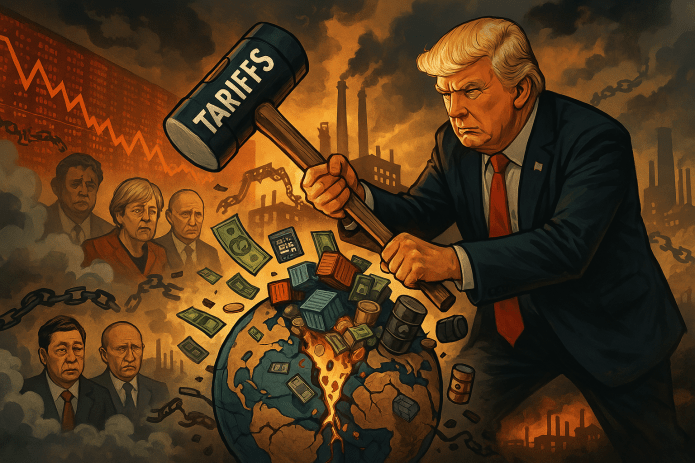
Impacts of Trumps Tariffs on the world

Reassessing Trump’s Tariffs from a Risk Management Perspective: A Reckless Gamble or Necessary Disruption?

In April 2025, President Donald Trump stunned global markets and diplomatic circles by announcing sweeping tariffs ranging from 10% to nearly 100% on imports from virtually all countries. Dubbed “Liberation Day” tariffs by the U.S. administration, the move triggered an immediate and intense backlash. Politicians, media pundits, and economists around the world denounced the action as reckless, economically unsound, and potentially disastrous for the global economy.

But such a one-dimensional, knee-jerk reaction may itself be dangerously shortsighted. From a risk management perspective, it is precisely in moments like this, when established norms are shaken, that we must resist emotional reactions and instead engage in cool-headed analysis. We need to pause, reflect, and ask deeper questions:

Continue reading

Narrative Walls: The Roadblocks on the Path for Peace in Ukraine

Hundreds of thousands of soldiers have died on both sides. Millions of Ukrainians have been displaced, scattered across Europe. Entire regions ravaged by war lie in ruins. Ukraine’s economy is effectively on life support, dependent on foreign aid. Russia, too, faces deep losses and isolation. And yet, the war continues with only a barely flickering flame lighting up a tortuous path towards peace.

That flickering light is primarily due to the forceful actions of a new ‘peace broker’ in town, US President Trump, who is now trying to twist the arms of both sides to broker a ceasefire deal and bring the warring parties around the same table. That’s not easy! The challenge is not that peace is impossible in itself. It’s that even the possibility of peace has gradually been buried beneath the rubble of hardened ideologies, pain, losses, raw emotions, and distrust expressed in mutually exclusive narratives. The real tragedy may not just be the terrible loss of lives and territory but also the loss of the ability to see the other side as anything else than mortal enemies and hence to be unable to imagine peace with them as even a remote possibility.

Continue reading
Voting does not count

A DEMOCRATIC BREAKDOWN IN EUROPE

A Case Study of the 2024/2025 Romanian Presidential Election 

What happens when the clear frontrunner in a presidential election is prevented from running when the election is abruptly cancelled just days before the second round of the vote?

This isn’t a scene from a political thriller. It’s the reality unfolding in Romania, a member of the European Union (EU). The 2024/25 Romanian presidential election presents a sobering case study that raises questions not only for Romania’s democratic health but also about some broader, troubling trends affecting the state of democracy across the EU.  While European nations continue to promote democratic values abroad, events like these raise serious concerns about the democratic integrity at home. Let’s look into it.

Continue reading

City Harvest Case part 6: The Smog of the Crossover Financing

The revelations about the large sums of money (tens of millions of dollars) used liberally to finance Sun Ho’s failed attempt to breakthrough on the U.S. music scene and about her carefree, luxury lifestyle, have shocked many City Harvest Church members, the christians community at large and even the wider public. Reading through online forums, it is clear that many people felt that the amounts spent were extravagant and questioned what this “U.S. pop star adventure” had really got to do with the Christian evangelisation project it proclaimed to be. Continue reading

City Harvest Case part 4: Can you Rationalize a Crime to be Beneficial to Society?

Every week Pastor Kong Hee and Pastor Tan Ye Peng both preach eloquently about good ethical principles solidly grounded in the Bible. Through many sermons, they have warned repeatedly the faithful crowd convincingly about the deadly power of sin and how easy it is to be tempted and fall on the wrong side. How could the same men of God, as the COC Report and the prosecution claim, be doing the contrary of what they preach? Continue reading

City Harvest Case part 3 – The Opportunity Makes the Thief

Social scientists, psychologists and criminologists generally agree that human behavior is the product of a complex interaction among a wide range of factors. Some of those factors are personal to the individual and others are related to the environment in which the individual evolves. The Fraud Triangle Risk Assessment model that I have been using for this analysis of the CHC case categorize these factors into 3 groups: Pressure, Opportunity and Rationalization.  Continue reading

City Harvest Case part 2: If There is a Fraud What Would be the Motives?

As already mentioned in my previous post City Harvest Case Part 1: Following God or Mammon?, the COC and the prosecution claim that at least SGD 24 millions were illegally diverted from the church building fund and channelled to finance Sun Ho’s attempt to breakthrough on the Hollywood music scene. In order to find out whether there could be any real substance (or not) in the allegations made against the CHC leaders, I will explore this case using a well-tested and recognized Fraud Risk Management Analytical Framework: The Fraud Triangle.  Continue reading